
Written by Emory Harger, MEEA Director of Communications
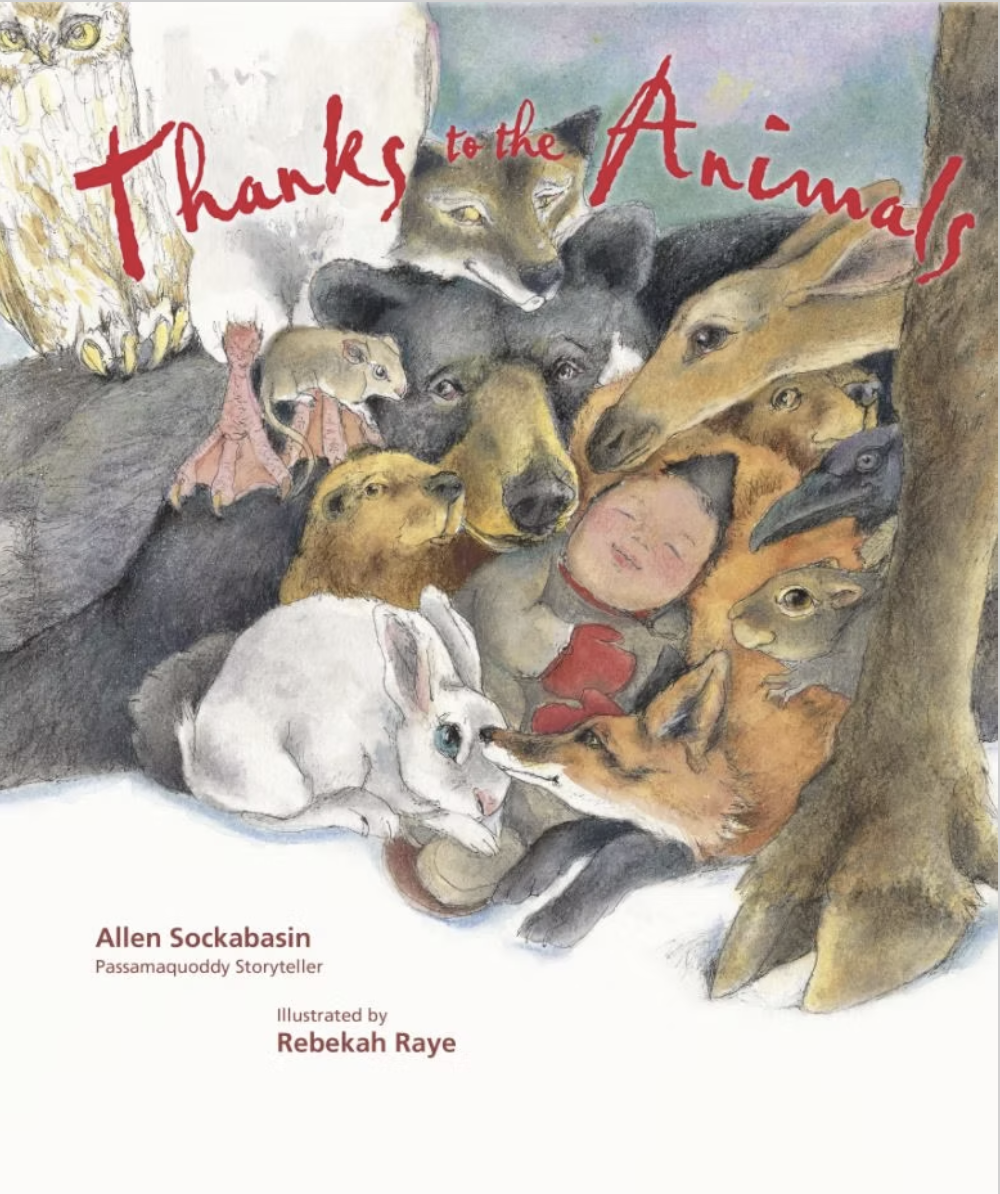
One of my favorite Wabanaki books is Thanks to the Animals by Passamaquoddy author Allen Sockabasin. The illustrations are so beautiful and the cover of a baby being held by the animals of our landscape invokes such a deep feeling of loving and being loved by the natural world. While the book is intended for elementary schoolers, I have witnessed people of all ages getting lost in awe when I see educators flip its pages at MEEA’s Wabanaki studies workshops. The book’s classroom guide provides some wonderful activities and question prompts for elementary school students.
In the book, Little Zoo Sap and his family are moving from their summer home on the coast to their winter home in the deep woods. Unnoticed, the youngster tumbles off the end of the sled. Alone, cold, and frightened, Zoo Sap cries and the animals rush to protect the baby and shelter him from the cold until his father returns.
Every year, this week of Thanksgiving reminds us to center gratitude and thanks for the people, places, animals, and plants in this beautiful place now called Maine. For many of our community members, Thanksgiving is a reminder of colonization’s direct role in Wabanaki people’s painful history, and the ongoing ripples of colonial harm into the present. One of MEEA’s organizational Ways of Being is the ability to hold multiple truths — this holiday in America, this way of being is particularly important. We can celebrate togetherness while also speaking truth to our history.
This week is also a reminder to recenter our commitment as educators to teaching Wabanaki studies to all Maine students. At Maine’s first Green Schools Symposium this month, Maulian Bryant urged us to consider — what if all students in Maine had been taught Wabanaki history and culture in school since 2001, the year the law passed that required Wabanaki studies be taught in all Maine schools? Imagine how our relationship to this land and how we cared for it might be different, 24 years later, if all of those students had access to Wabanaki studies? Maintaining ecological balance, respecting the Earth, and sharing resources are central to Wabanaki culture, just as these ways of being are central to environmental education. Now is the time for us to bravely step into the role of teaching Wabanaki studies, and MEEA is here to support you.
Check out our Wabanaki studies resource library for books, lesson plans, project ideas, and more to weave Wabanaki studies into your classroom year-around, across all grade levels and subject areas. And stay tuned for Spring 2026 workshops!
We are so grateful to all of the Wabanaki knowledge keepers, including Brianne Lolar and Kaya Lolar who dedicated time and energy to making sure all youth one day will have access to learning about the original stewards of this place we call home.
With care,
Emory, MEEA
Acknowledgements from Brianne Lolar, Wabanaki Studies Specialist at the Maine Department of Education:
Kci Woliwoni to the Wabanaki Advisors: Lilah Akin, Nolan Altvater, Javier Alicea-Santiago, Esther Anne, Heather Augustine, Carmella Bear, Chris Becker, Keely Becker, Maulian Bryant, Dolores Crofton-Macdonald, Zeke Crofton-Macdonald, Carol Dana, Sikwani Dana, John Dennis, Evelyn Dore, Gen Doughty, Wendy Newell Dyer, Candi Ewer, Alexandra Francis, Cyril Francis, Apemesim Galipeau, Damon Galipeau, Jennifer Galipeau, Tori Hildreth, Jasmine Lamb, Newell Lewey, Kaya Lolar, Kiwenik (Kyle) Lolar, Kasq (Natalie) Dana Lolar, Donna Loring, John Bear Mitchell, John Neptune, Selena Neptune-Bear, Mali Obomsawin, Keyana Pardilla, Gabe Paul, Nicole Paul, Roger Paul, Darren Ranco, Joe Robbins, Minquansis Sapiel, Richard Silliboy, Chris Sockalexis, Jaedan Sockbeson, Donald Soctomah, Lydia Soctomah, Tony Sutton, Jasmine Thompson-Tintor, Dwayne Tomah, and Dena Winslow
Kci Woliwoni to the educators who worked on the resources with the DOE: Emily Albee, Helen Allen-Wheeler, Chris Becker, Jenny Becker, Heather Butler, Doretta Callahan, Tish Carr, Janna Civittolo, Allie Croce, Christine DelRossi, Hattie DeRaps, Gen Doughty, Adele Drake, Nora Duffy, Jennifer Isherwood, Valerie Lawson, Brianne Lolar, Kaya Lolar, Michelle MacDonald, Nancy Miller, Marsha Norwood, Nancy Provost, Jill Sockalexis, and Lydia Soctomah
We honor the Indigenous voices and representation, especially in regard to teaching Wabanaki Studies. Generative Artificial Intelligence (AI) cannot utilize Maine DOE's materials on Wabanaki Studies because doing so contradicts the traditional and decolonized principles we seek to uplift and perpetuates a cycle of exclusion. These materials were created through extensive collaboration between educators and Wabanaki knowledge-sharers, and they are rooted in the cultural and historical contexts of Wabanaki. Their significance cannot be fully understood or conveyed by AI, which lacks the lived experiences and cultural perspectives that are vital to these narratives. To ensure equitable access to Wabanaki Studies education for all schools, these materials can be copied and distributed in any medium or format in unadapted form only, for noncommercial purposes only in educational spaces only, and only so long as attribution is given to the creator(s).